Dear Carolyn
When I was about 15 years-old, and fist listened to a song called, Carry Me, Carrie, I heard the observer (Dr Hook and the Medicine Show) telling me a story of a loving and decent man who was let down by a heartless wife or partner. I was young and my brain wasn’t developed enough to delve deeper into the story. As the years went by, and I experienced life through wiser eyes, I became fixated on this song asking myself what lay behind the lyrics. For me, Carry Me, Carrie became a paradox within itself.
I have since discovered the intended story behind the song. An explanation offered by Uncle Stylus. However, I thought I’d now share my older and wiser alternative to what I originally thought about the abandoned man with his foot wrapped in an old rag. And, of course, as always, there is a moral to my version.
Author: Mark Bolton. Subbing: DeepSeek. Images: CHAT GPT
INTERPRETATION (Surnames, jobs and circumstances are my creation)
The Glitter & The Trap:
Carrie Evans met Ben Rogers in the sterile, fluorescent light of St. Vincent’s orthopedic ward. He was charming, disarming even through the pain of a shattered thumb from his motorcycle wipeout at the corner of Second Street, and Broadway. He painted word-pictures of his journalistic ambitions at the LA Times. She was captivated by his intensity, his seeming worldliness. Their attraction was instantaneous, a wildfire fed by youthful recklessness and the thrill of the moments they shared.
Ben, tall and magnetic; Carrie, was beach blonde and radiating a healthy vibrancy he seemed to crave. They mistook lust for destiny. He was ever the romantic, helpful and even carried her over the threshold when they arrived home after the wedding, which took place six months after they set eyes upon each other. That’s all it took for Ben’s whirlwind charm and Carrie’s long dreamt-about fairytale romance to collide in a courthouse marriage. A decision made in the afterglow, and before the true Ben had rolled in.

The Cracks Appear (The Mountain Emerges):
The Hyde to Ben’s Jekyll didn’t wait long. The charming journalist vanished with the first bottle. Carrie had never seen him drink until the first week after they were married. He stumbled home at 3 AM, reeking of cheap bourbon and cheaper regret. The apologies were operatic the next morning – tears, self-loathing monologues, vows etched in trembling air. “Carrie, you’re my rock… I have this mountain, baby… this awful mountain inside me… I need you to help me climb it. I can’t do it without you.” Carrie was taken by surprise when Ben admitted that during the months they dated, the times he said he was away on a newspaper assignment, he was actually on benders.
He quickly weaponised his vulnerability, framing his addiction as a shared burden, a mountain they had to conquer. “Carrie, I carried you over the threshold of not only our home, I carried you into my life–they were actions and not words, and actions are what counts in true love.” Carrie, gullible because of love, not naivety; compassionate and trained to heal, believed him that first time and each time he repeated the cycle. She caught glimpses of the man she married and those fleeting visions saw her through until the next violent outburst, and those next times became more frequent as the months dragged by. She tried support groups, gentle interventions, hiding the liquor. The mountain, however, was Ben’s alone, and he refused to take the first step without her pointing him in the right direction.

The Descent:
Ben’s arrogance, fuelled by alcohol, destroyed his career. Furious over a perceived sligh–a big story given to a more seasoned reporter–he drowned his resentment in a downtown bar. Liquid courage turned to liquid violence. He stormed into the LA Times office, fists flying, landing blows on his editor before security hauled him off. Charges filed, dignity incinerated. Hours in the drunk tank only inflamed his rage.
Now unemployed, his reputation demolished, he had reached what he felt was rock-bottom. Instead of facing his demons, he consumed them.
The Breaking Point:
That night, their two worlds again collided, this time love and lust were not the combustion point. Drunk, enraged by the world and especially by the wife he blamed for his failures. He screamed with a ferocious venom she’d never before seen, “If you were stronger, I wouldn’t need this!” That was it for Carrie, she stopped being his “rock” and concluded that she was his enabler.
Ben then unleashed a horror Carrie couldn’t have imagined. The beating was savage. The rape was an act of pure hatred and domination, a violation that shattered any lingering illusion of love or shared burden. When he passed out, Carrie, broken in body and spirit, crawled to the phone. The St Vincent’s ER staff–their colleague was in desperate need of help. Their silent horror spoke volumes.
The Walk Away:
Lying in a hospital bed, mirroring the ward where they met but under cruelly different circumstances, Carrie made her choice. She pressed charges. Ben, facing the assault of his editor, and spousal rape/assault charges, wailed his pleas from a jail cell. “Climb the mountain with me, Carrie! Don’t abandon me now! I need you!” The mountain metaphor, once a plea for shared struggle, now sounded like a demand for shared damnation.
Carrie saw it clearly: He had abandoned her long ago, every time he chose the bottle over her safety, her love, her very being. He abandoned himself to the demon he refused to fight. His seven-month sentence wasn’t her abandonment; it was the consequence of his choices, his violence. She filed for an annulment. She walked away to save herself.
The Barstool Lament:
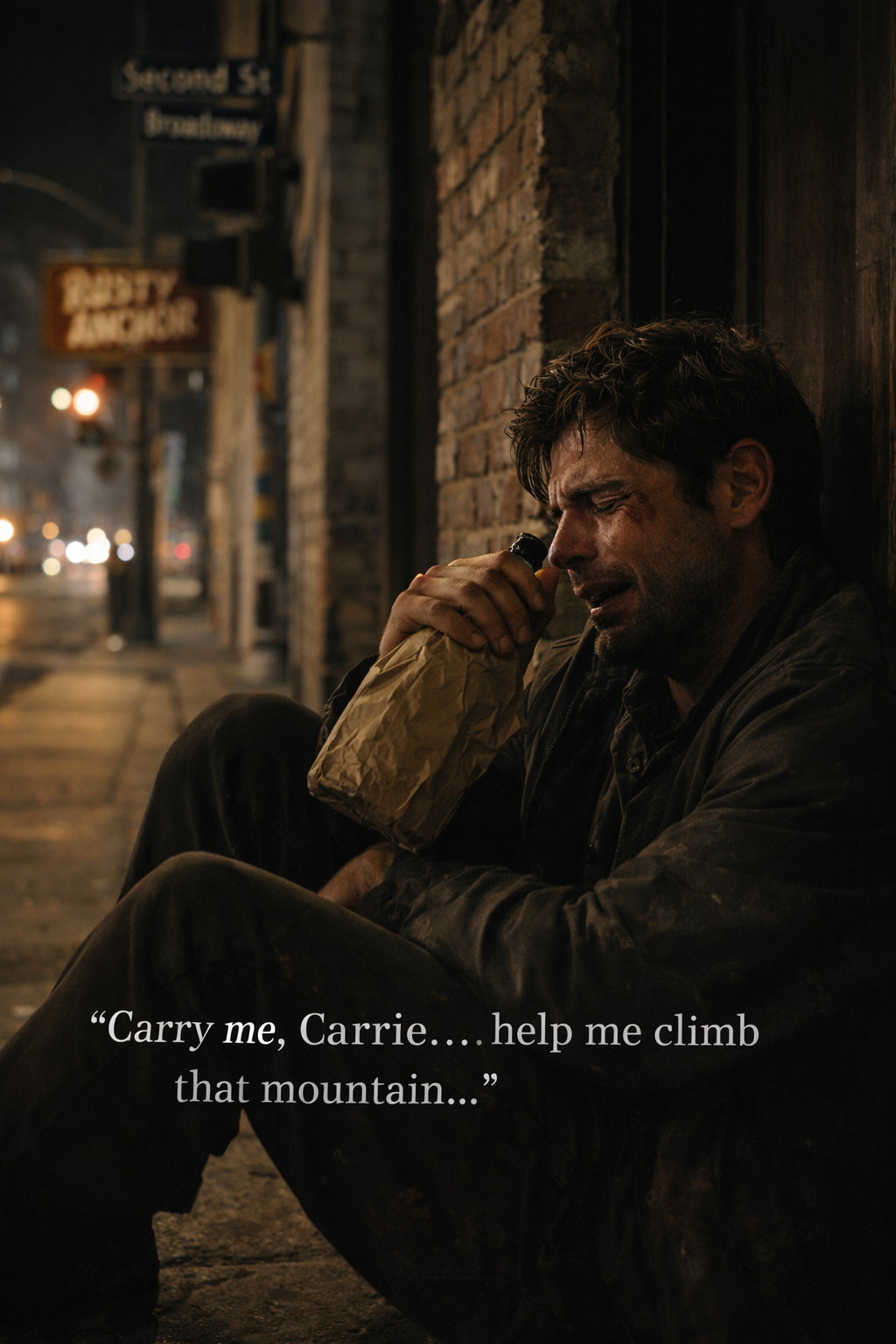
Now, Ben haunts The Rusty Anchor, a bar filled with losers and brawlers. At closing time, he returns to Second Street and Broadway, a three minute stagger from The Rusty Anchor, and there he crawls into an empty doorway with his cheap wine bottle in a brown bag to escape in a comatose state of sleep.
To the observer, Ben is a pitiful figure: slurring Carrie’s name, weeping into the bottle, spinning tales of woe about the woman who “left him when he needed her most.” He paints himself as the victim of a cruel world and a faithless woman. He sings the same refrain: “Carry me, Carrie… help me climb that mountain…”

The Observer hears the raw pain in Ben’s voice, sees the wreckage of a man, and feels sympathy. He hears Ben’s truth. The Observer doesn’t see the hospital brace on Carrie’s wrist, the nights she jumped at slamming doors, the terror in her eyes when she finally signed the papers. He doesn’t see the mountain of violence and betrayal Ben forced Carrie to climb alone just to survive. He doesn’t see Carrie alone at home every night–too scared to try again for a shared happiness.
The Truth Behind the Plea:
Ben doesn’t want Carrie to help him climb his mountain. He wants her to carry his burden up the mountain while he stays exactly where he is, at the bottom, bottle in hand. He longs for her to return so he can blame her for his stagnation, his failure, his pain. Her absence is the only tangible consequence he faces, and it fuels his narrative of victimhood.
Carrie didn’t abandon Ben. She escaped him. She refused to be crushed under the weight of his mountain any longer. Ben abandoned Carrie – and himself – with every drink, every lie, every raised fist, long before she walked out the door.
The Morals:
- The Danger of the Single Story: The Observer only hears Ben’s drunken lament. It’s compelling, it’s sad, it paints a picture of loss. But it’s a curated performance of victimhood, obscuring the terror and violence that preceded the abandonment. There is always another side, often silenced by fear, shame, or simply not being the loudest voice in the bar.
- The Mountain is Your Own: Ben’s central failing was outsourcing his recovery. “Climb the mountain with me” became a demand for Carrie to fix his sorrow. True recovery, overcoming any profound struggle (addiction, grief, trauma), requires the individual to take ownership and do the climbing. Others can offer support, tools, and love from base camp, but they cannot carry you up. Carrie realised she couldn’t climb for him, and staying meant being buried under his landslide. Ben’s tragedy is that he still waits at the bottom, screaming for his sherpa instead of looking for a foothold. Carrie’s strength was realising she had her own mountain – survival, healing, reclaiming her life – and she chose to climb it alone. Only healing and time will show if she reaches the summit.
Yes it is dark fiction, but just because it is my interpretation of a song that was not the real story, doesn’t make it untrue. Women from every culture, status or intelligence do fall victim to a man who presents as the thing he does not want them to see until he knows he can unleash the monster and take control. That behaviour is dangerous because it is premeditated.

Leave a Reply