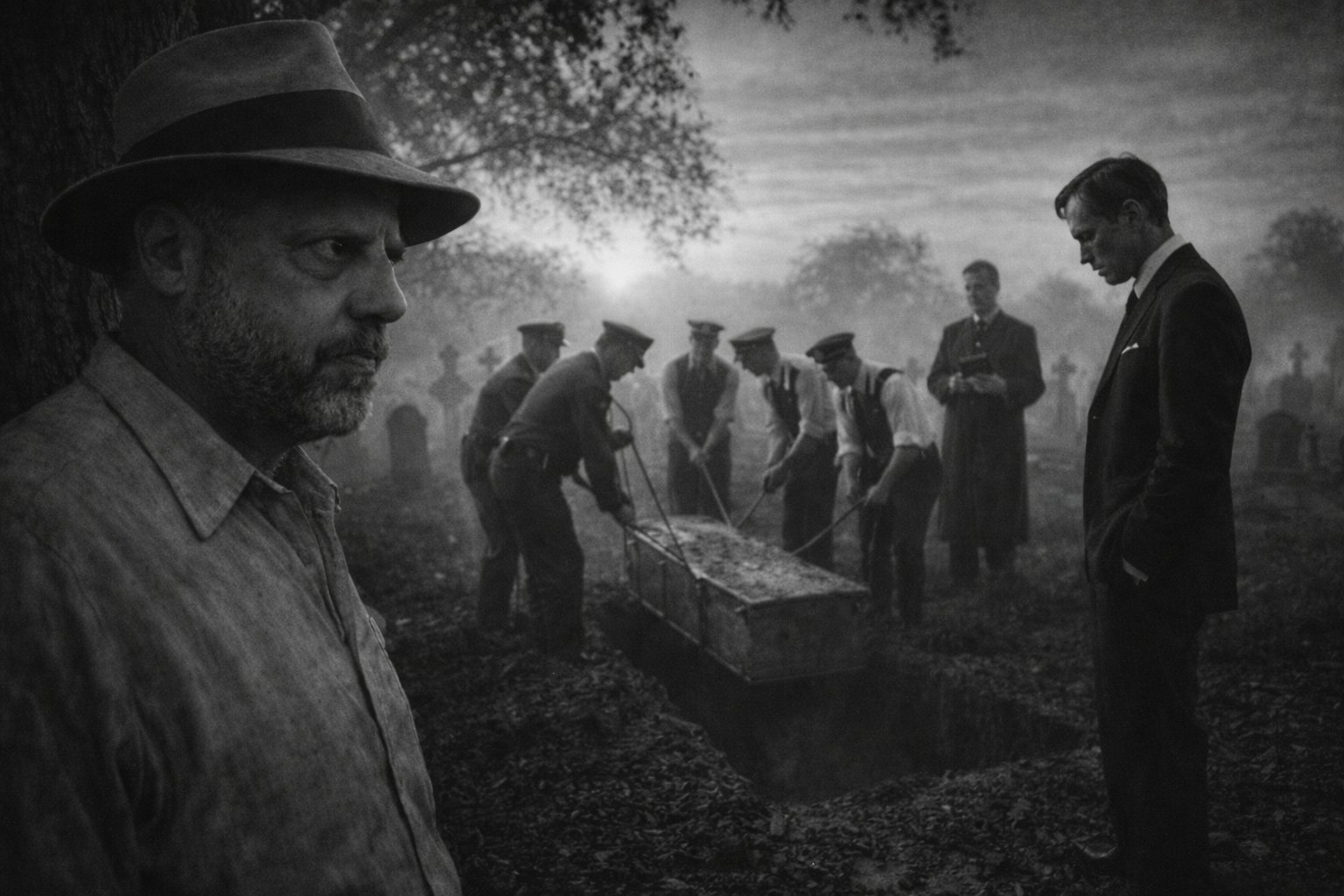
Author: Mark Bolton. Co-Written: DeepSeek. Images: Stated below each one. The images with the names on the photos themselves are AI recreations of the newspaper sketches.
Dear Carolynn

This is a story I've carried for years, set in the style it demanded—Film Noir—because some tales are too tangled for anything else.

It happened here in Brisbane, 1917. I moved it to summer. The heat suited the darkness better.

It's about a murder trial. But really it's about how certainty kills—whether from the pulpit, legislature, or the bench. Pro-life. Pro-choice. Both right. Both wrong. Sometimes wrong and right weigh the same.

I won't hide behind Duke Guytee. His words at the end are mine.

Sadly, this is a true story. Some I've trimmed, some I've shaped to simplify the complexities. The characters outside the trial are borrowed—from life, from Fritz Lang, from Hammett—and, until I finished the story, from my late father, himself a newspaper crime reporter. His ghost subconsciously rides shotgun in Duke Guytee.

Grab a coffee, a beer or a whiskey. It's a short story, but in this day and age, a long read.
NOTE: The subject matter mentioned above might be triggering.

Chapter 1: Tenacity Valley
The air was thick. Thick like a steam bath in a cheap hotel. The kind of heat that doesn’t just sit on your skin, it seeps into your bones and makes you think hell might be cooler if you could find the door. A thunder storm with cooling rain had teased us earlier, a few minutes of cool relief that was just another kind of torture, because it never lasts. When it fizzles out, the steam rises from the sticky hot streets like a bad idea, simmering. Even the rats had more sense, staying down in the cool of the sewers.
It was nearly midnight. I was on the roof of my apartment block, trying to catch a breeze that didn’t exist. Sleep was a rumour. Four nights. Four long nights of clothes soaked through, of tempers shorter than a gambler’s luck. Half the town was ready to jump out of its skin, and I had a feeling… the kind you get in your gut when you’ve been around long enough… a feeling that something was about to blow.
My name is Duke Guytee and this is my habitat. ‘Tenacity Valley’. It’s where I work, eat, sleep and drink. My world moves fast. See, I’m a newspaperman. The ink is in my blood and the story is the only dame that’s ever kept my interest for more than a few days. There’s always another one around to replace the last one.
Tenacity Valley. It’s a unique ecosystem of strange bedfellows, locked in a waltz so close you can’t tell who’s leading and who’s getting a shiv in the ribs. The muscle needs the brass badges, the badges need the silk-suited politicians, and the politicians need the muscle. It’s a three-way tango in a cheap hotel outhouse that has no light on Boxing Day, and everybody’s hoping they are stepping on toes and not something else.
The glue holding this beautiful, rotting mess together? The ink-stained wretch. The guy who sells the sheep their daily fairy tale—a typewriter jockey like me. I’m the one who whispers the warnings in print, who keeps the wolves just hungry enough not to eat the sheep all at once. We co-exist, or we go the way of the Dodo Bird. In Tenacity Valley, those who don’t drink the culture… let me tell you, sister, you either take the next steam train out or you get your name in print… the obituary page.
I work both sides of the street—one side wants the story told and the other doesn’t, and at half-time they swap sides. I’m the guy they love to hate and hate to need. I’m a tool, and I don’t mind getting my hands dirty if it means digging up the truth as I see it. The truth always makes a winner and a loser.

Chapter 2: Squib Can’t Sleep Either, But He Never Does!
Almost 4am and the steam bath heat hasn’t broken. It continues to cling to the rooftop of my apartment block like a curse, a solid weight on the chest. Sleep remains a distant country.
A shadow detached itself from the stairwell bulkhead—a skinny kid named Squib, all elbows and anxious eyes. He is a runner for the paper, but his real talent is listening at windowsills. He sidled up, smelling of sweat and newsprint.
“Got a tip for ya, Mr. Guytee,” he whispered, a grimy piece of folded note appearing in his hand like a magician’s trick. “From a fella who knows a cop’s wife. Says the blue boys are gonna be busy at Toowong come first light.”
I didn’t ask how ‘a fella‘ would be getting the dope from a cops wife during the early hours of a hot and humid morning. I didn’t need to. None of my business, anyway. Besides, the cop was probably getting his somewhere in one of the non-existent illegal Tenacity Valley love palaces that advertise their services in my newspaper.
I took the note from Squib’s hand and asked, “They’ll be busy how?”
“Diggin’,” Squib hissed, his eyes wide. “Gonna lift a box. A woman. Went missing just before the start of summer. They got a tip on where she might’ve ended up.”
A name floated up from the sludge of forgotten police briefs.
“Mabel Cameron?”
Squib just shrugged, “dunno” was his reply as he melted back toward the stairs.
The note in my hand felt heavy. It wasn’t just paper; it was another act of a Tenacity Valley tragedy. I already sensed this was going to be big story, and I wasn’t wrong.

Chapter 3: What Cockney says ‘A Wee Drrrrarm’
The first grey light of dawn found me leaning against a peppercorn tree in Toowong Cemetery, the air still thick enough to drink. Not even twenty-feet away is a large group of people sobbing as a coffin is being lowered into the ground. And only a few feet from me, a scene with all the solemn dignity of a sewer repair. A handful of coppers in shirtsleeves stood around a fresh-turned mound of clay, their faces grim. A minister looked like he’d rather be anywhere else, prayer book clutched like a shield. And there, off to the side, looking like a man watching his own future being unearthed, stood a pale, well-dressed chap.
I recognise him. William Cameron, a two-bit theatre vocalist by night and during the day tends bar on Brunswick Street. It was a joint that smelled of stale beer and yesterday’s regrets. But with war rations, a good meal was rarer than an honest man. The cook there, he could fry an egg so it tasted like a promise, and his rabbit… it fell off the bone and melted in your mouth like a secret you were sorry to keep.
For months I’ve been eating and watering myself at that dive. Listening to that sad-sack bartender pour out his troubles with my bourbon. A Scotsman who talks like a bad actor playing the role of a Cockney in London’s East End. All the right sounds, all the wrong music—telling me how miserable he is after his wife skipped town on him. I’d nod, making sympathetic noises, adding his sob story to the heap while thinking that dame had the smarts to ditch this clown.
So… he’s the husband of the missing dame, Mabel Cameron. My senses were now as high as an alley cat standing downwind from the docks when a good catch comes in. The whole damn time he’s been serving me my drinks with his alibi as a chaser.
A missing dame named Cameron and a loser named Cameron moaning about his wife taking off on him. The answer wasn’t in some dark alley. It was on a well-worn rag, wiping down a bar top I lean on from time-to-time. I must be slipping. Makes me wonder what else I’m missing when it’s sitting right in front of me, looking me in the eye.
Cameron didn’t shed a tear. He just watched, hollow-eyed, as the plain pine coffin, barely stained with earth, was hauled up from the paupers section of the cemetery and into the miserable new day. My question was answered the moment he looked in to the opened shell and nodded.
His fear tells me it is the missing Mabel Cameron. But how did she get in there? And why was she buried under the name May Jackson? Did he put his wife in there? If so, how did he manage it? Lots of seedy deals can be done in Tenacity Valley, but this caper takes smarts—doesn’t fit. Cameron is the type who would take a wrong turn riding a merry-go-round.

Chapter 4: Get Your Lemonade and Pies
That was the prologue. The real story started a few days later in the City Police Court. The Great War had been raging for three years and almost everybody in Australia has been tarred with grief and sadness. This yarn is a tonic for the country—a chance to peer through the keyhole of some other poor slobs melancholia.
The court was a sardine can of human curiosity, packed tight and sweating under a low ceiling. The air wasn’t breathed; it was recycled, thick with the smell of cheap perfume, stale wool, and a kind of grim excitement that left a metallic taste on the tongue. It buzzed—a low, constant hum of whispers and shifting feet, the sound of a hundred hungry flies circling the same piece of bad meat.
Outside, under the brassy sun, the stragglers who’d arrived too late mill on the steps, a jostling chorus line of the disappointed. They wait for the bulletins, for the lucky ones inside to come out and spill the grim details like a bucket of guts. The heatwave has broken… but it is still summer. Enterprising vendors are cleaning up, hawking lukewarm lemonade and stale pies. Tragedy was always good for business in this town. It made people thirsty.
I saw a young couple near the doors. She was holding his arm—the only one he had left. One of his legs was a polished crutch. Gallipoli had taken its pound of his flesh and then some. But they were both smiling, leaning into each other, their eyes bright with a feverish gleam as they caught scraps of the horror show inside. It was the first bit of good news they’d had since the night before he shipped out, maybe. When the world’s worst news isn’t yours, it can feel like a holiday. It made me sick, but I understood.
I lit a cigarette, the smoke a feeble curtain between me and the whole sad, grinning parade. I was part of the machine, too. The difference was, I knew I was. And some nights, that knowledge sits heavier than the heat.

Chapter 5: The Stars of the Show Arrive
Being heard by Chief Police Magistrate, Archdall, the charge was read out like a bad omen: Murder. Strangely, William Cameron is named as a key prosecution witness, as is Nurse Jessie Byrne. The defendants: William Trouton, chemist, and Norah Phillips, nurse. The deceased: Mabel Cameron, alias ‘May Jackson.’
This case is becoming more confusing than a jigsaw puzzle printed in reverse; with more unpredictable cogs than a rigged roulette wheel that sometimes slips and cheats the house.
The formalities over, this case is adjourned and the real stuff starts tomorrow morning.

Chapter 6: The Arch Duke
I have a front-row seat to the many spectacles that play out in the committal hearings. The conductor of this out-of-tune symphony is the wily old fox himself—Chief Police Magistrate, Hewan Leslie Archdall. The gavel is his baton, and he wields it like a surgeon’s knife, cutting through the noise with a look that could frost glass.
Me and Arch have had many a run-in along the way. He’s raged at my copy more times that I care to remember, and once threatened to hold me in contempt if I didn’t stop smoking in the back of his court. But I like him. He’s a straight shooter. Looks older than he is—like the weight of every lie he’s ever heard has settled into the lines on his face—but don’t let the white hair fool you. The eyes behind those spectacles are sharp as shaved ice. He sees the play, the players, and the pit orchestra of human misery all at once.
And he doesn’t mind sharing his private bar with a cynical old newspaperman when the day’s gavel falls.
“Another circus, Duke,” he’d say, pouring two fingers into a glass that had seen better decades. If the Queensland taxpayers ever sent me an invoice for the whiskey I’ve sipped in his chambers, I’d have to flee the state in the dead of night.
“Same clowns, different day, Arch,” I’d reply, taking the offering like a sacrament.
I see how he reflects on his day before we settle into a conversation. He listens to the parade of liars, fools, and professional victims with the patience of a glacier. He lets the lawyers dance their dance, but when the noise from the gallery of ghouls get too loud, he doesn’t shout. He just turns those cool eyes on them, and the silence that follows is heavier than any gavel crack.
He is a wise man. Wise enough to know that sometimes justice isn’t about finding the truth, but about managing the fallout. Wise enough to keep an extra bottle in his desk for the days when the fallout was particularly grimy.
It is a dirty job. But somebody has to do it. And in Tenacity Valley, I am glad it is him.

Chapter 7: The Committal Continues
The Crown’s star was William Frank Cameron himself. He took the stand looking like a man who’d slept in his conscience and found it full of lumps. Under the slick cross-examination of McGrath, Nurse Norah Phillips’s lawyer, Cameron unraveled like a cheap sweater.
Yes, his wife was pregnant. No, he didn’t buy her medicine and didn’t know William Trouton the chemist. No, he didn’t assault his wife because she got pregnant. Did he tell her she’d have to ‘get fixed up’? A weak denial. Why no inquiries as to her whereabouts when she vanished? His answer, delivered in a tone so low the magistrate had to lean forward, and it became our headline: “I WAS AFRAID!”
He’s afraid of what? A rebuff? The truth? His own shadow? Cameron painted a self-portrait of a man so paralysed by fear he’d let his wife vanish into thin air, and over the following months pawn her jewellery, take up with another woman, and spin a kaleidoscope of lies to the police. One of God’s greatest creations stood before us all.
It was beautiful, brutal work. By the end, Cameron wasn’t a grieving husband; he was a liability to the Crown in a suit.
The most damning evidence came from the mouth of a cop. Detective Senior-sergeant Donnelly laid it out. How Cameron’s story finally broke after a marathon interrogation at the CI Branch. How Cameron had approached Trouton to organise an abortion, and Trouton sub-contracted Nurse Phillips, who in turn sub-contracted Nurse Byrne.
Armed with Cameron’s admission to the CI Branch detectives, they confronted the cold chemist owner. During the many hours of interrogation, how Trouton, agitated, denied it all. Then, the clincher: they brought Nurse Phillips into the interrogation room. She then pointed the finger at Trouton, said he’d introduced her to Mabel Cameron and he had given her powders. Trouton, faced with it, calmly said, “No; not me.”

Chapter 8: A Spoonful of Honey Makes the Medicine Go Down.
Trouton was yet another glorious creation by a God who should know better. He had the kind of face you’d see behind a chemist’s counter—pale, precise, hair groomed with mathematical severity. He looked like a man who measured misery in grains and drams, who saw a human tragedy and calculated the exact cost of the coffin before adding his profit. Clean hands. That was the worst part. In a room swimming in sweat and sin, his hands looked like they’d just been scrubbed.
A hot wave of disgust washed over me, bitter as battery acid. I’d be angry at God right now if I believed there was one who cared enough to stop dirtbags like these from existing. Only God knows what misfired with Trouton, a man full of greed and indifference… with a keen eye for the vulnerable. He wasn’t a monster from the shadows. He was the respectable kind of monster. The kind that gives you correct change while selling you your own doom.
Trouton sat perfectly still, listening to the litany of his alleged sins with the mild interest of a man checking a ledger. No sweat on his brow. No twitch in his clean fingers. Just a cool, clinical presence amid the fever-dream of the court. Another freak in the carnival, sure. But the most dangerous kind—the one who doesn’t think he’s in the sideshow. He thinks he’s running the ticket booth.
The crowd murmured, leaning forward, hungry for the next morsel of his disgrace. They didn’t see the calculation behind his eyes. They just saw the villain of the piece, neat and packaged. And they loved him for it. He was the reason they’d skipped work. The reason the lemonade was selling. He was the best bad news they’d had all week.
I ground my cigarette under my heel hoping old Arch didn’t catch a glimpse. The show will go on tomorrow and bound to be another sellout.
I proceeded to the newspaper office and filed my story from today for the upcoming Sunday. My paper, The Truth has a bit of a reputation for spinning the facts. If spinning means sensationalising… no denial. People want the good bits and we provide them. Supply and demand. With this yarn there will be little shortage of supply to give what the customer demands.

Chapter 9. You Just Put Your Lips Together and Blow.
After my story was filed, the Empire pub next door was still open. “Hey, Frank, give me my usual“, I yelled from the front door so I didn’t have to wait a few extra seconds. Reaching the bar, a dame sitting on a stool next to where I stood chastised me for my accent. She was a real doll, so I gave it to her easy.
“You sound like you just got off the boat from Buckingham Palace. Every pale face here sounds like a Yorkie, Paddy, Scot Welsh, or Cockney. Only ones who talk Australian are the blacks, and they talk straight. The only ones in this country who do!” “Yeah, I’m American, I’m also not very tall but I can whistle”.
She has eyes that could melt the ice caps and start another great flood. She said nothing and I was left with two choices. Walk away and regret a missed opportunity, or take the next step.
“I’m Duke, sister, what’s your name?”
“Veronica“, she replied with that British plumb sultry voice. “I know who you are… I’ve been watching you for some time now because I like your style. And if we’re going to get along as I plan, never call me sister again.“
I let out a whistle sound that replaced the word ‘Wow’. I’m a sucker for straight talking dames, especially ones who look and talk like this one.
Veronica looked me up and down before asking another question about me. “So, Dee-uke, what brings you to Australia?”
“See, I make it my business to know things. Who’s on the take, who’s behind it all, who’s cheating on wives, who’s beating them, who they’re cheating with. Don’t know what it is about powerful, corrupt men—they all have the same taste, and it ain’t with dames if you follow me“.
“I grew up in the Bronx. New York. The moment I was old enough to write I was knocking on the door of every newspaper in the city. One old editor, Sam Drucker was his name—crusty old demon but he knew the newspaper business, thought the best way to see less of me was to put me on the payroll. He wasn’t disappointed.”
“I was still a kid and got around without anyone thinking I was anything but a kid. Nobody put up their guard around me and I’d hear things.
“Sam Drucker, rest his soul backed me in. Told me I’m doing what a newspaperman must do. When I wrote a story that shone a light in an unwanted direction, I was sent a message. A beating. Professional job. Hurt me bad enough I should wish I’d died, but not so bad I wouldn’t heal up useful. My only regret is Sam copped it too but they found him floating in the Hudson“
“I was forgotten in 24 hours. So was Sam. The replacement editor, a company man more focused on sucking up to the owners bottom line than real news, had a replacement at my desk by morning. Whether I was dead or not.“
“The cops who organised the beating thought the mob finished me off and the mob thought the cops finished me. My bartender poured a memorial shot. My landlord sold my things—wasn’t much—and rented my room. Even the stripper I was seeing got scared and blew town. I thought that was a pretty smart plan. Decided the best thing for me was a long vacation. An old pal of mine from the Bronx days was a porter and smuggled me on board the ship he was assigned to, which was heading to Brisbane. The Truth newspaper noticed me. The rest is history.“

Chapter 10: The Crystal Ball Says There Will Be Trouble!
Although the heatwave is well and truly in the past, the atmosphere in the City Police Court just got hotter and thicker. The Cameron case had moved from front-page scandal to a grim, grinding institution. This was the committal: not the trial, just the legal machinery deciding whether there was enough rust and grease to justify the full, terrifying engine of a Supreme Court murder trial. It moved with the speed of a dying man’s confession.
I was in my usual spot, press row, the wood stained with the sweat of decades of cheap whiskey and thousands of regrets. The defendants were set: Trouton the chemist, face like a closed ledger; Phillips the nurse, looking smaller every day; and the ghost of Mabel Cameron hovering over it all.
First up is the daughter of Nurse Jessie Byrne, Mary McLeod, who offered grim details: the slowly dying moans from the room, the sight of a still-born foetus on the bloodied mattress, and the desperate, delaying dance before fetching a doctor.
Then Nurse Jessie Byrne, smelling of mothballs and bad decisions took the stand. Under oath, she unfolded a tale that was less an accusation and more a confession of moral numbness. She spoke of the dying girl she knew as, May Jackson.
She repeated what her daughter had earlier told the court. The sordid Clayfield details: the room, the hot water, the girl getting sick. The foetus on a bloodied mattress, adding that they eventually burned that mattress in the back yard. She described Nurse Phillips hissing at her to keep quiet, to just say the girl took sick, and the promise she made to Nurse Norah Phillips, “My lips are sealed.”
Then came the kicker. After the ambulance carted the dying girl away, where did Nurse Byrne go? Not to the hospital. Not to the cops. She went to a fortune teller. A Tenacity Valley shingle-hanger who operated a mystic shop named ‘Zephoria’s on Brunswick Street’ next to the railways station. Zephoria peered into the murk and told her, “There will be trouble over this.” It would have been funny if it wasn’t so utterly, perfectly damning of the whole rotten town.

The defence lawyers—McGrath for Nurse Phillips, and Crawford for William Trouton—took turns peeling Nurse Byrne like a rotten fruit. They picked at her memory—conveniently soft. They aired her own dirty laundry, other “mishaps” she’d overseen. They cornered her on why she, a nurse, didn’t just call a doctor straight away. Her answer was a masterpiece of cowardice, delivered with a shrug: “I thought it was Mrs. Phillips’ business.”
Nurse Byrne wasn’t a Crown witness; she was an accessory.
Through it all, William Frank Cameron sat like a haunted portrait. His usefulness to the Crown was crumbling under the weight of his own proven lies. He was no longer a grieving husband; he was a problem. A liability in a cheap suit.
The legal chess got dirty. Crawford, for Trouton, made a desperate, clever move. He argued that any statement Nurse Phillips made in front of Trouton at the C.I. Branch was inadmissible. Why? Because Trouton, he claimed, was deaf. Gasps came from the crowded gallery.
McGrath, for Phillips painted the cops as thugs who put the “screw” to his client, plying her with brandy for strength before using the drunk Nurse Phillips to turn the screw again even further on Trouton.
Both defences called what took place in the CI Branch interrogation room a monstrosity. That the whole dramatic confrontation was a pantomime for Trouton who is so full of himself he couldn’t hear the knife being sharpened. Archdall brushed it off, but the seed was planted. The case wasn’t just built on sand; it was sand being shovelled into a deaf ear.
Finally, the Crown wheezed to a close. The defense lawyers stood for the ritual slaughter. Crawford eviscerated Cameron as a “principal,” a liar “worse than Ananias.”
Old Archdall listened, his face like a stone idol. He wasn’t moved to dismiss. The law, in its ponderous, blind wisdom, demanded the spectacle continue. He committed them both. William Trouton and Norah Phillips would stand trial for murder in the Supreme Court.

I filed my story and found Veronica at The Empire pub. She’d read the bare bones in the afternoon edition of a daily paper called ‘The Telegraph‘.
“So they’re committed. It’s real now,” she said.
“It’s a ticket to a bigger stage,” I corrected, swirling the ice in my glass. “That’s all a committal is. The magistrate just said the show has enough legs to limp to a higher court. The Crown’s got a lying husband, a nurse who takes advice from carnival psychics, and a chemist they had to shout at. It’s not a case. It’s a recipe for reasonable doubt.”
“But they’re surely going to face the rope?”
“No, Veronica, they’re facing a jury,” I said, finishing my drink. “And juries are made of people. People who get confused. People who smell a rat. People who look at a William Frank Cameron and think, ‘I wouldn’t buy a used horse from that guy, let alone hang two strangers on his word.’ The committal just guarantees the next act. It doesn’t write the ending.”

Chapter 11: The Trial – The House Always Wins
The Supreme Court is a different beast. Cooler marble, higher ceilings, the heavy scent of old money and older fear—and higher priced legal representations. The public gallery was a packed, all eager eyes and morbid fascination. This was the main event.
It opened with a masterstroke. Trouton’s lawyer, Blair, applied for a separate trial. He called the evidence against his client “manufactured,” said the cops staged confrontations like a cheap vaudeville act. The gallery chuckled (Nurse Phillips has two famous comic vaudevillian daughters who sometimes played the roles of brainless characters).
Justice Chubb, a man who looked like he’d seen every trick in the book, agreed. He called it “horrible.” With a wave of his hand, he split the case. Trouton would be tried alone, first.
Phillips was sent back to the cells. The Crown’s case, built on the intertwining stories of two accused, was cut in half before the jury was even sworn.
What followed was a slow, surgical dismantling of the Crowns case against Trouton.
The Crown Prosecutor, Kingsbury, opened with a whimper, conceding they weren’t going to argue “wilful intent” to murder. The air seeped out of the room.
Then came Detective Donnelly. And under Blair’s razor-sharp cross, the detective admitted it: Cameron’s first statement was a “pack of lies.” He admitted they’d held Cameron for thirty-two hours to get the “truth.” He admitted they’d dragged Trouton in to confront him with this proven liar, Cameron. No denial that the detectives gave alcohol to Nurse Phillips before having her confront Trouton. It wasn’t investigation by the CI Branch; it was coercion dressed in a blue uniform.

Then Cameron himself took the stand. It was a car crash in slow motion. Blair didn’t even need to attack; he just guided the jury’s eyes to the wreckage. “What I told them was a pack of lies.” Cameron recited, a broken record of his own making. Blair asked him if he’d been an “unmitigated liar.” Cameron, pathetic to the last, muttered, “I don’t know the meaning of the word.”
The other witnesses—Nurse Byrne, her daughter, the doctors—floated past like ghosts. They placed a dying girl in a Clayfield room rented out by Nurse Jessie Byrne. They couldn’t place William Trouton in the crime.
The jury was out for four minutes. Four! “Not guilty” on the charge of murder. The gallery gasped.
But the house always has another game. Before Trouton could taste his freedom, the Crown stood up. They dropped the murder charge against Phillips and then filed a fresh, lesser indictment against both: conspiring to procure an abortion. A consolation prize. A misdemeanor to salvage from the felony wreckage.

Nurse Norah Phillips’s trial the next week was a funeral for a case already buried—and this one won’t be exhumed. Her lawyer, O’Rourke, gave the eulogy. He didn’t just defend her; he put the police on trial. Praised Donnelly’s “thoroughness,” arguing that if he couldn’t find evidence of a crime, there wasn’t one. He turned their own sword into a shield.
The judge, in his summing up, gave the official epitaph for William Frank Cameron: “an unrestricted liar.” The jury was out for sixteen minutes. “Not guilty.” On all counts.
The Crown stood and abandoned the last conspiracy charge against Trouton. The game was over. The table was cleared.

Epilogue
Back at The Empire pub, the silence was absolute. Veronica just stared past me, waiting for the wisdom. I had none. Just the facts.
“They’re out,” I said, my voice flat. “Both of them. The chemist is back behind his counter. The nurse is back doing abortions. The husband… he’ll drift on the tide of his own shame, until the next scandal washes him away.”
Veronica looked sad and asked, “And Mabel Cameron?”
“She’s gone back home to Warwick where she and her family have lived for the last 20 years. Cameron, Trouton, Phillips, Byrne, her husband and daughter… they all knew Mabel’s true identity but allowed her to lay alone dying, and then die alone in a hospital while authorities tried to track down and inform May Jackson’s family. Those same people, and Zephoria the crystal ball reader… all kept quiet as Mabel Cameron was buried in the paupers section under the name of May Jackson. These are the worst types of people.“
“Donnelly is a first rate detective but he wanted this one bad for Mabel and her grieving family. He let his emotions rule his tactics and he made rookie mistakes. He’s a good man and sometimes good men care too much. The crown lacked wisdom and accepted William Frank Cameron and Nurse Jessie Byrne as witnesses for its side… a man so incapable of telling the truth and a nurse so indifferent that they should have been defendants and not witnesses.”
I lit a cigarette, the flare illuminating the empty glasses between us.
“The law spun its wheels for months, ate up column inches, and packed courtrooms. The system didn’t fail. It functioned. It absorbed the mess, chewed on the facts, and spat out the only result that wouldn’t give it indigestion: reasonable doubt.”
I blew a smoke ring, watched it dissolve into the stale air.
“That’s the real verdict of Tenacity Valley. Not ‘guilty’ or ‘not guilty.’ It’s that the truth is too heavy, too ugly, and too damn inconvenient. So we bury it. We give it a fake name and a cheap coffin. The law isn’t here for justice. It’s here to manage the smell.”
Veronica fixed me with a look. One of those looks that doesn’t ask, it pries. Like she had a tin opener for a stare and my skull was the can. She wanted what was rattling around in my head, all right, but her mouth was stitched up tight with silk thread.
“It’s called a noble cause. Allowing an unwanted infant to be born. Fine. But I’ve got a question for the pious, the planners, the pencil-pushers who draft laws from leather chairs: what exactly are these kids being born into?“
“A cold street? Growing up thinking it’s normal for a mother to get a backhander from a drunkard husband? A young accidental mother-to-be tossed out like yesterday’s news for doing the one thing that’s as natural as breathing?“
“They best not talk to me about God. Not here. If there’s an Almighty up there, He lost interest a long time ago. What we’ve got instead is dogma. Idealism dressed up in Sunday best, parading like it cares about life. But life according to who? And at what cost?“
“How many more dames are going to end up pushing up daisies because they mistimed? Or worse—because they never had a say at all? How many more dolls get the moonlight promise? The whispered dream of a penthouse view? Only to find out they’re just a temporary diversion. A shiny toy. And when the toy gets… complicated. How many more will lay down on a strange woman’s kitchen table—the same table where a family ate breakfast not an hour before—because it was the only door that wouldn’t slam in their face?“
“Mabel Cameron is one. Just one name in this year’s already crowded ledger. She trusted a backroom deal. Maybe the nurses intentions were good. Maybe they thought they were helping. But intentions don’t stop infection. Idealism doesn’t sterilise a syringe. Safety wasn’t available to her.“
“It makes me wonder. What would this town look like—what would any town look like—if these back-alley deals weren’t the only choice on the menu? If a desperate dame didn’t have to trade her life for a chance at living?“
“You show me a woman who walks away from this choice with her heart untouched, and I’ll show you a liar. It follows them. It lives in the silence between their breaths. It’s in the shadow behind their sleeping eyes and every time they see a pram in the street.“
“This law isn’t about right or wrong. This is about what’s real. And in the real world—women are dying on tables, benches and alleys because we’d rather judge them than help them. How many others are buried in pauper graves with no names, and families wondering? Mabel and her family just got lucky if you can call it that.”
Mabel Cameron (nee Gerish)
Born: 17 July 1887, Brisbane, Queensland, Australia. Married: 20 December 1916, William Frank Cameron. Died: 9 May 1917, Brisbane, Queensland, Australia. Footnote: About four years before she died, Mabel found herself caught up in scandal. William McElvey blew into Warwick, promised to marry her, took her to Toowoomba and—well, you know. She was rescued in Brisbane sometime later. Poor Mabel—she sure managed to find the scumbags.
William Frank Cameron
Birth: Circa 1891, Scotland or London. Arrived: Circa 1911. Married: 20 December 1916, Mabel Gerish. Died: Unknown when or where. Footnote: Cameron abandoned a daughter born in 1918 to Julia Kirkpatrick. A warrant was put out by New South Wales police for his arrest for refusing to pay child support. Cameron was seeing another woman after Mabel left home for the termination. Maybe even before. There was never a mention of a Julia during the trial. It’s quite possible Cameron was seeing Julia after the Mabel left home to meet up with Nurse Phillips at Trouton’s chemist shop.
William Israel Roberts Trouton
Birth: 6 July 1882, Ipswich, Queensland, Australia. Married: 22 February 1910, Amy Harriett Twemlow. Divorced: December 22 1926, brought by Amy due to “Misconduct“–aka he was caught red handed with another woman. Amy made her ex-husband’s life miserable by not letting a grub like him off the hook. Died: 13 March 1964, Brisbane, Queensland, Australia. Footnote: It is a bizarre irony that Trouton’s father died the same day as Mabel Cameron
Honoria Kate Phillips (nee Conn)
Born: 1872, Ireland. Arrived: 26 November 1883 Brisbane, Queensland, Australia. Married: 22 April 1891, William Joseph Phillips. Died: 12 June 1935, Brisbane, Queensland, Australia
Jessie Byrne (nee O’Neill)
Born: Circa 1877 in a place unknown, but not Australia. Arrived: Circa 1896. Married 26 January 1897, Charles Patrick Byrne. Died: 14 September 1959, Brisbane, Queensland, Australia.
Tragically, Phillips and Byrne went on to inflict more tragedies because there were no safe places for women to see help.
Personal note: I hope that whatever dimension my father is now living in, it is a high contrast black and white world, where the light is there only to support the shadows. And I also hope my late brother is again dad's cub reporter learning on the job.

Leave a Reply